



- Joined
- Oct 12, 2023
- Messages
- 176
- Reaction score
- 31
Even if you are not new to doing keyword research, shifting into prompt research can feel like stepping onto a moving treadmill. Suddenly it’s not just what people type into Google – it’s how they talk to AI bots like ChatGPT, Claude, Gemini, and Perplexity. And people talk to AI very differently than they talk to search engines.
This guide walks you through the basics of prompt research for Generative Engine Optimization (GEO) and how it compares to keyword research. Whether you run a small candle shop or a fast-growing tech startup, you’ll leave with a clear, practical workflow you can actually use to uncover the prompts that help AI engines mention your business more often.
Generative AI engines don’t approach web content the way Google does. Instead of scanning pages and listing links, they take prompts like they’re part of a conversation. And then they generate what they think is the best answer using any data they can find online – your website, social media, Wikipedia, and third-party sources.
Prompt research helps you understand:
If you’re just getting familiar with the concept, understanding what is Generative Engine Optimization is a good primer on how generative engines think.

Source: Pexels
The easiest way to understand the difference is to imagine two people searching for the same thing.
Person A (doing a classic keyword-led search):
best domain names pet shop
Person B (entering a long-tail, detailed prompt in natural language):
“I’m opening a small pet store. What’s a good domain name that doesn’t sound spammy?”
Both want the same thing, but the second approach gives you far more detail, personality, and intent. That’s why more marketers are adding prompt research for AI engines into their workflow to understand how people communicate with AI.

Source: Pexels
Here’s something most people don’t realize about generative engines: they don’t just take your question and answer it. They break it apart into dozens of mini-questions behind the scenes. This behavior is called query fan-out.
For example, when a user asks:
“What’s a good domain name for a new pet store?”
In the background, the AI quietly generates related queries like:
Then, the AI engine blends the answers to those queries together to create a single reply.
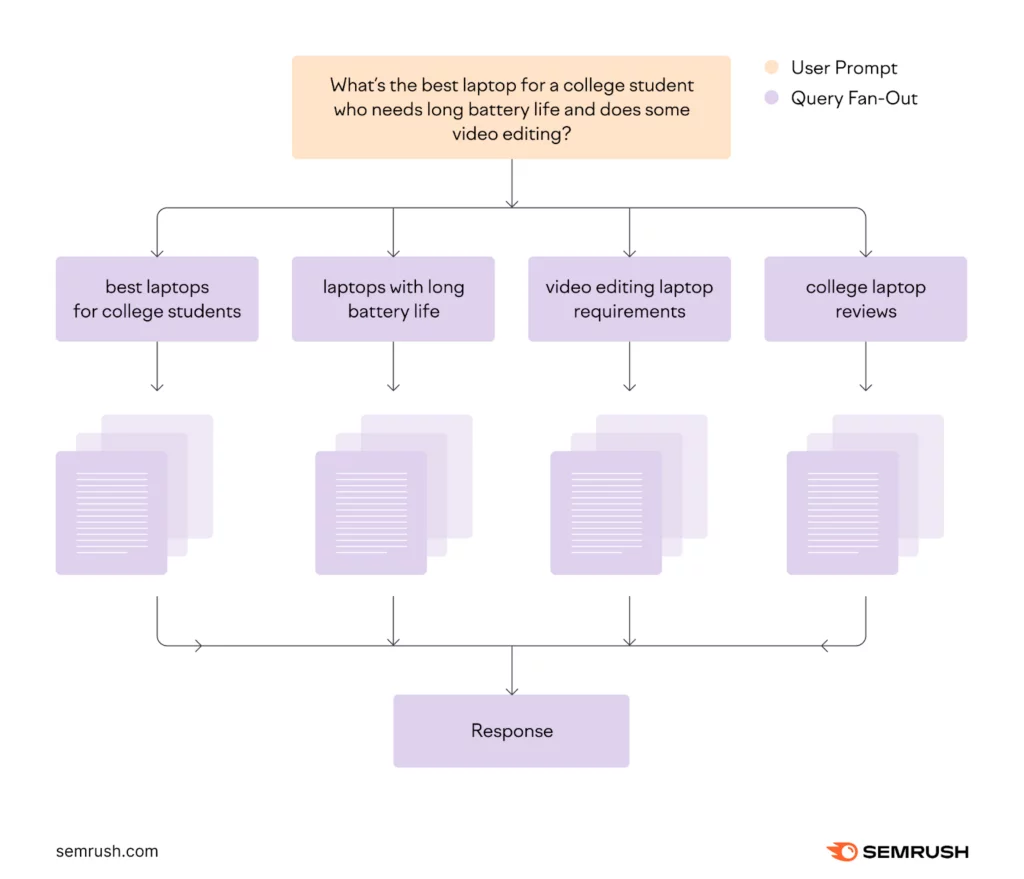
Source: Semrush
If your content supports various related topics, your chances of appearing in the final response from AI go up – even if the original prompt didn’t match your site word-for-word. You can see similar patterns when optimizing for ChatGPT search, where context matters as much as content.
When attempting prompt research, there are two top-level types you’ll run into, and they behave quite differently.
These come from AI tools or GEO platforms when you ask to generate a list of prompts relevant to your product or business. They’re tidy, polished, and sometimes a little too polite.
Example:
“What are the most effective domain name strategies for small businesses?”
They are useful but not based on real data and do not represent organic conversations.
These come from actual user behavior – clickstream data, long-tail search queries, community forums, Google Ads SQRs, and social platforms. They might look a bit messy and often contain typos or awkward phrasing.
Example:
“is .it.com ok for a tech startup or not lol”
Both types matter: synthetic prompts fill in the gaps, and real prompts keep you grounded to the actual requests your audience might type in. In discussions like this popular question on Reddit, GEO researchers share their experiences with combining both approaches.

Source: Pexels
Let’s face it – tools like ChatGPT do not yet offer first-party analytics data to pull the prompts from (similar to, for example, Google Keyword Planner for keyword research). So while there is no one-size-fits-all platform for prompt research, a combination of tools can get a result comprehensive enough to start a GEO program..
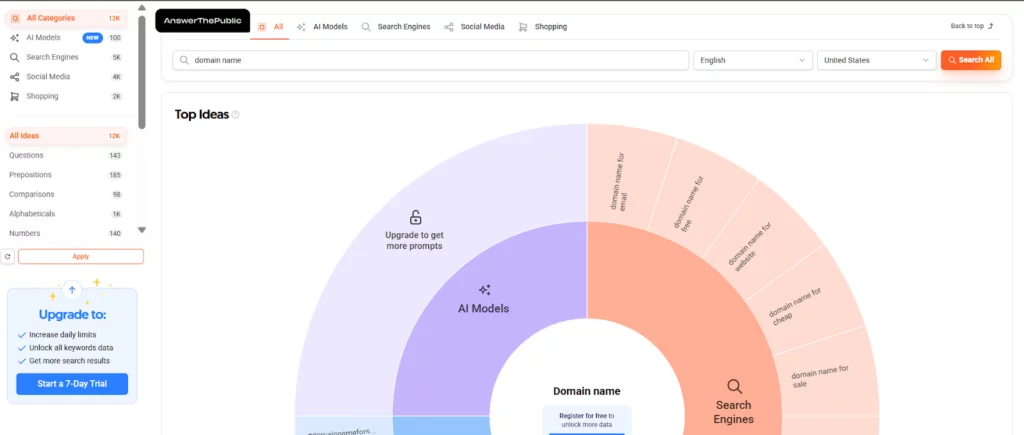
Source: AnswerThePublic
Here’s a step-by-step process you can reuse for any industry. Each step includes a prompt you can plug into ChatGPT or your preferred AI tool.
Open ChatGPT, Claude, Gemini, or Perplexity and ask what questions people usually ask about your topic.
Try this prompt:
“List 20 questions people typically ask AI assistants about [your product or service]. Organize them by intent.”
Reddit, Quora, Slack groups, YouTube comments – anywhere users talk freely, you’ll find how people actually phrase their questions. It’s often the most honest source.
Some GEO platforms uncover the prompts that drive specific generative answers. Others monitor brand mentions across AI engines.
Try this:
“Act as a GEO researcher. Suggest likely prompts that could produce AI answers about [topic]. Sort them by importance.”
Tools like SEMrush and AnswerThePublic pull natural-language questions from search data. GSC and SQRs add real-world phrasing that often translates directly to prompts.
Look for:
Group them into categories like:
This makes it easier to write content that resonates with multiple user needs.
Pay attention to:
This step often reveals gaps your content can fill.
If users keep asking:
“Which domain extension works best for tech startups?”
you can write content that compares options and share examples like greenbyte.it.com or cybertrail.it.com.
Working with prompts this way helps both GEO and traditional SEO.
User language changes, new questions pop up, and competitive landscapes shift. GEO isn’t static, and your prompts shouldn’t be either.Monitoring tools like Profound help identify when AI engines start mentioning your brand – or when they stop.
Prompt research is quickly becoming one of the most valuable skills for understanding and improving a brand’s visibility across generative engines. Instead of guessing what users might ask, you’re studying how they actually speak – and building content that fits those conversations.
By understanding query fan-out, using both synthetic and real prompts, and combining GEO tools with SEO favorites like SEMrush and Search Console, you’re better equipped to show up in generative answers across the web.
A prompt is the question or instruction someone gives to an AI engine like ChatGPT. It can be short, detailed, or wildly specific. The wording shapes the answer the model gives.
Prompt research for GEO is the process of studying the natural phrases users ask AI systems. It helps you understand user intent and create content that stands a better chance of being included in generative answers.
Keyword research for GEO blends traditional keyword analysis with natural-language prompts. You look at long-tail keywords, question-heavy queries, community discussions, and AI prompt patterns to build a broader understanding of what users want.
You can monitor prompts by tracking which questions trigger AI-generated answers about your brand. Tools like Profound help surface these prompts and show how often your brand appears across generative engines.
You can ask ChatGPT directly or use LLM monitoring tools. You can also watch for prompts like “Which companies offer [product]?” to see if your business appears in the answer.
Looking for tips on Generative Engine Optimization? Visit it.com Domains blog and follow us on social media.
Continue reading on the it.com Domains blog...
This guide walks you through the basics of prompt research for Generative Engine Optimization (GEO) and how it compares to keyword research. Whether you run a small candle shop or a fast-growing tech startup, you’ll leave with a clear, practical workflow you can actually use to uncover the prompts that help AI engines mention your business more often.
Why Prompt Research Matters for GEO
Generative AI engines don’t approach web content the way Google does. Instead of scanning pages and listing links, they take prompts like they’re part of a conversation. And then they generate what they think is the best answer using any data they can find online – your website, social media, Wikipedia, and third-party sources.
Prompt research helps you understand:
- How real people phrase their questions
- Why certain answers appear in generative engines
- Where your brand could appear, but currently doesn’t
- How to create content that aligns with what people actually ask
If you’re just getting familiar with the concept, understanding what is Generative Engine Optimization is a good primer on how generative engines think.
Source: Pexels
Prompt Research vs Keyword Research
The easiest way to understand the difference is to imagine two people searching for the same thing.
Person A (doing a classic keyword-led search):
best domain names pet shop
Person B (entering a long-tail, detailed prompt in natural language):
“I’m opening a small pet store. What’s a good domain name that doesn’t sound spammy?”
Both want the same thing, but the second approach gives you far more detail, personality, and intent. That’s why more marketers are adding prompt research for AI engines into their workflow to understand how people communicate with AI.
Source: Pexels
How Query Fan-out Shapes Generative Answers
Here’s something most people don’t realize about generative engines: they don’t just take your question and answer it. They break it apart into dozens of mini-questions behind the scenes. This behavior is called query fan-out.
For example, when a user asks:
“What’s a good domain name for a new pet store?”
In the background, the AI quietly generates related queries like:
- “tips for naming a pet business”
- “examples of memorable domain names”
- “what makes a domain trustworthy?”
- “best domain extensions for retail”
Then, the AI engine blends the answers to those queries together to create a single reply.
Source: Semrush
If your content supports various related topics, your chances of appearing in the final response from AI go up – even if the original prompt didn’t match your site word-for-word. You can see similar patterns when optimizing for ChatGPT search, where context matters as much as content.
Synthetic Prompts vs Real Prompts (Why You Want Both)
When attempting prompt research, there are two top-level types you’ll run into, and they behave quite differently.
Synthetic Prompts
These come from AI tools or GEO platforms when you ask to generate a list of prompts relevant to your product or business. They’re tidy, polished, and sometimes a little too polite.
Example:
“What are the most effective domain name strategies for small businesses?”
They are useful but not based on real data and do not represent organic conversations.
Real Prompts
These come from actual user behavior – clickstream data, long-tail search queries, community forums, Google Ads SQRs, and social platforms. They might look a bit messy and often contain typos or awkward phrasing.
Example:
“is .it.com ok for a tech startup or not lol”
Both types matter: synthetic prompts fill in the gaps, and real prompts keep you grounded to the actual requests your audience might type in. In discussions like this popular question on Reddit, GEO researchers share their experiences with combining both approaches.
Source: Pexels
Tools That Help with Prompt Research
Let’s face it – tools like ChatGPT do not yet offer first-party analytics data to pull the prompts from (similar to, for example, Google Keyword Planner for keyword research). So while there is no one-size-fits-all platform for prompt research, a combination of tools can get a result comprehensive enough to start a GEO program..
- AnswerThePublic takes real search questions and turns them into visual maps. It’s great for early idea generation and spotting phrasing patterns that sound like prompts users would ask AI tools.
- SEMrush offers question-heavy keyword data that often mirrors how people talk to generative engines. The newly launched AI toolkit is especially useful for research.
- Profound helps identify and monitor when AI engines mention your brand (or your competitors), which prompts lead to those mentions, and how those answers change over time. It’s one of the more GEO-specific options available and fits naturally into strategies covered in the it.com Domains’ guide to GEO tools.
- Google Search Console – even though it tracks organic queries from Google search come from Google, many of the longer ones translate directly into AI-style prompts. Users often write longer, more natural questions when they’re searching for help.
- Google Ads Search Query Reports give you the rawest version of user intent. They reveal the exact phrases people typed before clicking — spelling mistakes and all. Great for uncovering genuine prompt language.
Source: AnswerThePublic
How to Research Prompts for GEO: A Simple Workflow
Here’s a step-by-step process you can reuse for any industry. Each step includes a prompt you can plug into ChatGPT or your preferred AI tool.
1. Start by Asking Generative Engines Directly
Open ChatGPT, Claude, Gemini, or Perplexity and ask what questions people usually ask about your topic.
Try this prompt:
“List 20 questions people typically ask AI assistants about [your product or service]. Organize them by intent.”
2. Explore Community Threads
Reddit, Quora, Slack groups, YouTube comments – anywhere users talk freely, you’ll find how people actually phrase their questions. It’s often the most honest source.
3. Use GEO-focused Tools
Some GEO platforms uncover the prompts that drive specific generative answers. Others monitor brand mentions across AI engines.
Try this:
“Act as a GEO researcher. Suggest likely prompts that could produce AI answers about [topic]. Sort them by importance.”
4. Bring in Your SEO Tools
Tools like SEMrush and AnswerThePublic pull natural-language questions from search data. GSC and SQRs add real-world phrasing that often translates directly to prompts.
Look for:
- question-based terms
- “how to” phrasing
- comparison requests
- problem-first language
- intent-heavy long-tails
5. Organize Prompts into Intent Clusters
Group them into categories like:
- Informational
- Exploratory
- Comparison
- Buying decision
- Troubleshooting
This makes it easier to write content that resonates with multiple user needs.
6. Review How AI Answers Those Prompts
Pay attention to:
- language patterns
- recurring advice
- product features they highlight
- brands they tend to mention
This step often reveals gaps your content can fill.
7. Create Content That Fits Those Prompts
If users keep asking:
“Which domain extension works best for tech startups?”
you can write content that compares options and share examples like greenbyte.it.com or cybertrail.it.com.
Working with prompts this way helps both GEO and traditional SEO.
8. Keep Monitoring Your Prompts and Answers
User language changes, new questions pop up, and competitive landscapes shift. GEO isn’t static, and your prompts shouldn’t be either.Monitoring tools like Profound help identify when AI engines start mentioning your brand – or when they stop.
Prompt research is quickly becoming one of the most valuable skills for understanding and improving a brand’s visibility across generative engines. Instead of guessing what users might ask, you’re studying how they actually speak – and building content that fits those conversations.
By understanding query fan-out, using both synthetic and real prompts, and combining GEO tools with SEO favorites like SEMrush and Search Console, you’re better equipped to show up in generative answers across the web.
FAQs
What is a prompt?
A prompt is the question or instruction someone gives to an AI engine like ChatGPT. It can be short, detailed, or wildly specific. The wording shapes the answer the model gives.
What is prompt research for GEO?
Prompt research for GEO is the process of studying the natural phrases users ask AI systems. It helps you understand user intent and create content that stands a better chance of being included in generative answers.
How to do keyword research for GEO?
Keyword research for GEO blends traditional keyword analysis with natural-language prompts. You look at long-tail keywords, question-heavy queries, community discussions, and AI prompt patterns to build a broader understanding of what users want.
How to research prompts for LLM monitoring?
You can monitor prompts by tracking which questions trigger AI-generated answers about your brand. Tools like Profound help surface these prompts and show how often your brand appears across generative engines.
How to find out if ChatGPT mentions my brand?
You can ask ChatGPT directly or use LLM monitoring tools. You can also watch for prompts like “Which companies offer [product]?” to see if your business appears in the answer.
Looking for tips on Generative Engine Optimization? Visit it.com Domains blog and follow us on social media.
Continue reading on the it.com Domains blog...



