


- Joined
- Oct 12, 2023
- Messages
- 249
- Reaction score
- 44
Welcome to our monthly Industry News Digest. Explore new online trends and domain industry news to stay up-to-date. Here’s a summary for February 2026.
Decode, a developer of internet data mining software, reports that typosquatting (one type of cybersquatting) reached unprecedented levels in 2026. More than 28,000 domains resembling the names of 20 of the world's largest brands have been registered by third parties.
Common types of typosquatting include misspellings, keyword additions, registration in other zones, and the use of deceptive near-homographs, such as substituting ‘rn’ for ‘m’. These domains are often used for phishing and malware distribution.
Experts analyzed the domains of major brands and found that up to 13% of all possible variations of the original their domain names may be registered by third parties. Popular AI platforms such as ChatGPT (1,200 variations of typosquatted domains) and Gemini (more than 4,800 variations of typosquatted domains) are particularly vulnerable. Low registration costs and automation make typosquatting profitable, although individual domains may be useless. Large companies face security limitations, as registering every possible domain is prohibitively expensive.
The situation is exacerbated by the fact that fake domains appear in the early days of startups’ popularity, threatening their reputations. In the future, the conflict between registration ease and cybersecurity requirements will intensify. Companies need to quickly respond to breaches.
Why should you care? Brands lose traffic and reputation to typosquatting, sometimes being forced to spend resources buying back occupied domains spelled similarly to their name. To protect a domain name, it’s important to proactively register key spelling variations, especially in widely used and industry relevant extensions such as .it.com. Additional domains can be redirected to the primary address, parked, or migrated to an additional domain if necessary.
Source: Strategic Revenue
Afternic released a list of the most popular keywords in domains sold on its platform in December:
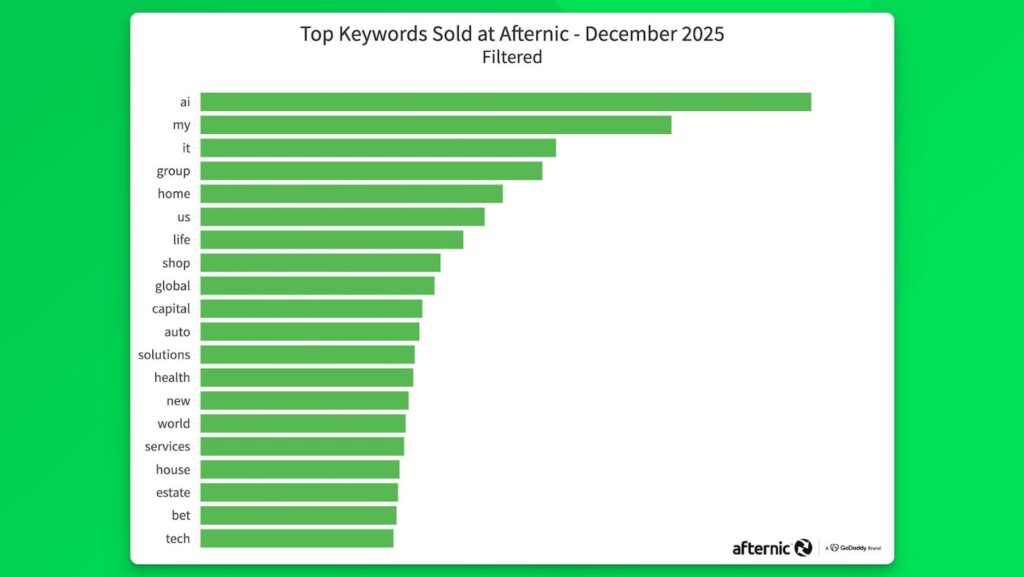
IT-related keywords haven’t lost their popularity; in fact, some, such as ‘IT’ are even rising in the rankings.
Furthermore, in its monthly review of the report, Domain Name Wire paid special attention to the word ‘solutions,’ even though it had dropped several places.
Andrew Allemann, a domain expert, says that despite the fact that ‘solutions’ is a lengthy term, it remains popular in the aftermarket, so he recommends paying attention to it.
Why should you care? Popular keywords provide important benchmarks for those planning domain registrations or optimizing existing addresses. The growing interest in the word ‘solutions’ reflects the growing demand for domains associated with problem solving in various fields, including IT. So, if your company operates in the technology or service sector, it’s worth considering domains featuring the term. A well-chosen domain extension can enhance the keywords in a domain name. For instance, a significant number of domains with the keyword ‘solutions’ are already registered in the .it.com suffix, as this combination naturally reflects a connection to the IT industry. This can work for both traditional domains (e.g. bestsolutions.it.com) and domain hacks such as dosolutions.it.com.
Source: Domain Name Wire
The number of monthly active users of Google’s Gemini chatbot exceeded 750 million as of Q4 2025. In the previous quarter, Gemini had 650 million users, while ChatGPT had approximately 810 million, demonstrating rapid growth in popularity.
Gemini’s user growth was recorded following the introduction of Gemini 3, the company’s most advanced model to date.
Google recently released Gemini 3, which delivers an unprecedented level of response depth. CEO Sundar Pichai noted that this has been a positive factor for the company's growth. Google has also introduced an affordable Google AI Plus plan for $7.99, which is expected to attract new users.
Why should you care? The growth of Google Gemini’s active user base indicates that generative AI is a mainstream tool for influencing audience behavior. This is important for marketers, SEO specialists, and website owners, as AI is already becoming the primary interface for interacting with information. Traffic conversion, visibility, and user engagement formats are changing; it’s now crucial not just to appear in traditional search results, but also to be relevant and accessible through AI tools like Gemini, including GEO (Generative Engine Optimisation) in your promotion strategy.
Source: TechCrunch
John Mueller, Google Search Team Lead, responded to a Reddit user’s question about sitemaps and explained that having a sitemap.xml file doesn’t guarantee the indexing of pages: if they’re unavailable to Googlebot, blocked by robots.txt, or are low-quality, the bot won’t index them. Furthermore, a sitemap may be ignored if the site structure and internal links already allow for effective content discovery.
Mueller also noted that errors in Search Console when retrieving a sitemap are often due to a lack of new and meaningful content. For Google to actively use a sitemap, a site must publish relevant and useful content and include elements that help visitors understand the topic or make decisions, such as images, instructions, or videos.
Why should you care? Understanding how Google processes sitemaps helps optimize your indexing and SEO strategy. This means that simply having a sitemap.xml file isn’t enough, you need to ensure that:
For businesses relying on organic traffic, it’s important to integrate a sitemap into a comprehensive SEO strategy rather than treating it as the only visibility tool.
Source: Search Engine Journal
Stay up-to-date with digital trends and news - visit it.com Domains blog and follow us on social media.
Continue reading on the it.com Domains blog...
Typosquatting in Domain Names Surges to Alarming Levels
Decode, a developer of internet data mining software, reports that typosquatting (one type of cybersquatting) reached unprecedented levels in 2026. More than 28,000 domains resembling the names of 20 of the world's largest brands have been registered by third parties.
Common types of typosquatting include misspellings, keyword additions, registration in other zones, and the use of deceptive near-homographs, such as substituting ‘rn’ for ‘m’. These domains are often used for phishing and malware distribution.
Experts analyzed the domains of major brands and found that up to 13% of all possible variations of the original their domain names may be registered by third parties. Popular AI platforms such as ChatGPT (1,200 variations of typosquatted domains) and Gemini (more than 4,800 variations of typosquatted domains) are particularly vulnerable. Low registration costs and automation make typosquatting profitable, although individual domains may be useless. Large companies face security limitations, as registering every possible domain is prohibitively expensive.
The situation is exacerbated by the fact that fake domains appear in the early days of startups’ popularity, threatening their reputations. In the future, the conflict between registration ease and cybersecurity requirements will intensify. Companies need to quickly respond to breaches.
Why should you care? Brands lose traffic and reputation to typosquatting, sometimes being forced to spend resources buying back occupied domains spelled similarly to their name. To protect a domain name, it’s important to proactively register key spelling variations, especially in widely used and industry relevant extensions such as .it.com. Additional domains can be redirected to the primary address, parked, or migrated to an additional domain if necessary.
Source: Strategic Revenue
Afternic: ‘IT’ in Top-3 Keywords
Afternic released a list of the most popular keywords in domains sold on its platform in December:

IT-related keywords haven’t lost their popularity; in fact, some, such as ‘IT’ are even rising in the rankings.
Furthermore, in its monthly review of the report, Domain Name Wire paid special attention to the word ‘solutions,’ even though it had dropped several places.
Andrew Allemann, a domain expert, says that despite the fact that ‘solutions’ is a lengthy term, it remains popular in the aftermarket, so he recommends paying attention to it.
Why should you care? Popular keywords provide important benchmarks for those planning domain registrations or optimizing existing addresses. The growing interest in the word ‘solutions’ reflects the growing demand for domains associated with problem solving in various fields, including IT. So, if your company operates in the technology or service sector, it’s worth considering domains featuring the term. A well-chosen domain extension can enhance the keywords in a domain name. For instance, a significant number of domains with the keyword ‘solutions’ are already registered in the .it.com suffix, as this combination naturally reflects a connection to the IT industry. This can work for both traditional domains (e.g. bestsolutions.it.com) and domain hacks such as dosolutions.it.com.
Source: Domain Name Wire
Google Gemini Chatbot Exceeds 750 Million Monthly Active Users
The number of monthly active users of Google’s Gemini chatbot exceeded 750 million as of Q4 2025. In the previous quarter, Gemini had 650 million users, while ChatGPT had approximately 810 million, demonstrating rapid growth in popularity.
Gemini’s user growth was recorded following the introduction of Gemini 3, the company’s most advanced model to date.
Google recently released Gemini 3, which delivers an unprecedented level of response depth. CEO Sundar Pichai noted that this has been a positive factor for the company's growth. Google has also introduced an affordable Google AI Plus plan for $7.99, which is expected to attract new users.
Why should you care? The growth of Google Gemini’s active user base indicates that generative AI is a mainstream tool for influencing audience behavior. This is important for marketers, SEO specialists, and website owners, as AI is already becoming the primary interface for interacting with information. Traffic conversion, visibility, and user engagement formats are changing; it’s now crucial not just to appear in traditional search results, but also to be relevant and accessible through AI tools like Gemini, including GEO (Generative Engine Optimisation) in your promotion strategy.
Source: TechCrunch
Google Explains Why Search Console May Ignore Sitemaps
John Mueller, Google Search Team Lead, responded to a Reddit user’s question about sitemaps and explained that having a sitemap.xml file doesn’t guarantee the indexing of pages: if they’re unavailable to Googlebot, blocked by robots.txt, or are low-quality, the bot won’t index them. Furthermore, a sitemap may be ignored if the site structure and internal links already allow for effective content discovery.
Mueller also noted that errors in Search Console when retrieving a sitemap are often due to a lack of new and meaningful content. For Google to actively use a sitemap, a site must publish relevant and useful content and include elements that help visitors understand the topic or make decisions, such as images, instructions, or videos.
Why should you care? Understanding how Google processes sitemaps helps optimize your indexing and SEO strategy. This means that simply having a sitemap.xml file isn’t enough, you need to ensure that:
- pages are accessible to Googlebot;
- there are no technical blockers (robots.txt, security filters);
- the content has real value and is unique.
For businesses relying on organic traffic, it’s important to integrate a sitemap into a comprehensive SEO strategy rather than treating it as the only visibility tool.
Source: Search Engine Journal
Stay up-to-date with digital trends and news - visit it.com Domains blog and follow us on social media.
Continue reading on the it.com Domains blog...


