


- Joined
- Oct 12, 2023
- Messages
- 249
- Reaction score
- 44
The digital landscape is moving fast. For small and medium-sized businesses, keeping up isn’t just an advantage, it’s a necessity. In 2026, the right technology can power smarter marketing, boost customer trust, and transform your website into a growth engine.
Whether you're launching your first site or looking to scale your online presence, now’s the time to tap into tech designed to make your business more agile, visible, and secure. From AI that writes and personalizes your content, to smarter ways to build and protect your domain, we have collated five of the most important tech trends every business owner should know in 2026.
Generative AI has become a “marketing sidekick” for SMBs, helping produce website content, blog posts, product descriptions, and more. Modern AI tools can draft articles, suggest keywords, and even optimize your website copy for better search visibility. Notably, search engines are themselves using AI to summarize answers for users, which means content needs to be clear and well-structured to get picked up.
AI is also changing SEO and reshaping it into Generative Engine Optimization – businesses are realizing the game is shifting from just ranking on Google to being the trusted source that AI assistants cite in their answers. With the launch of end-to-end AI experiences like ChatGPT Atlas AI-enabled browser, it’s crucial that your website speaks the same language as AI agents do.

Source: Pexels
Why it matters: high-quality content is key to attracting customers online, but producing it consistently is resource-intensive. A boost in content output from AI (when guided by human expertise) helps SMBs compete with larger firms in educating and engaging their audience.
In fact, 88% of organizations use AI in at least one business function, and many are now scaling up “agentic” AI systems for content and insight generation. By 2026, SMBs that figure out how to use AI to generate helpful, credible content will stand out against competitors and against a wave of low-quality AI spam.
Your website is the primary outlet for all this AI-generated content. Embracing AI-driven writing means you can keep your site updated with fresh blog posts, FAQs, and product info that attract search traffic.
It’s crucial, however, to maintain authenticity and accuracy – pairing AI with human review ensures content truly answers customer questions (and avoids factual errors). Structuring content for AI-driven search is also important: clear headings, schema markup, and authoritative info help AI search tools recognize your site as a trusted source. In short, AI content tools can amplify your website’s reach if used thoughtfully, with your domain becoming known as an authoritative hub for your niche.
Building and managing a professional website is now easier than ever thanks to no-code platforms and AI-assisted site builders. These tools allow SMB owners to create websites through simple drag-and-drop interfaces or even by having a conversation with an AI assistant.
For instance, GoDaddy Airo allows you to create a full AI-generated website in minutes. Similarly, modern no-code platforms (for websites and web apps) let you add features or integrations via visual editors instead of complex coding.
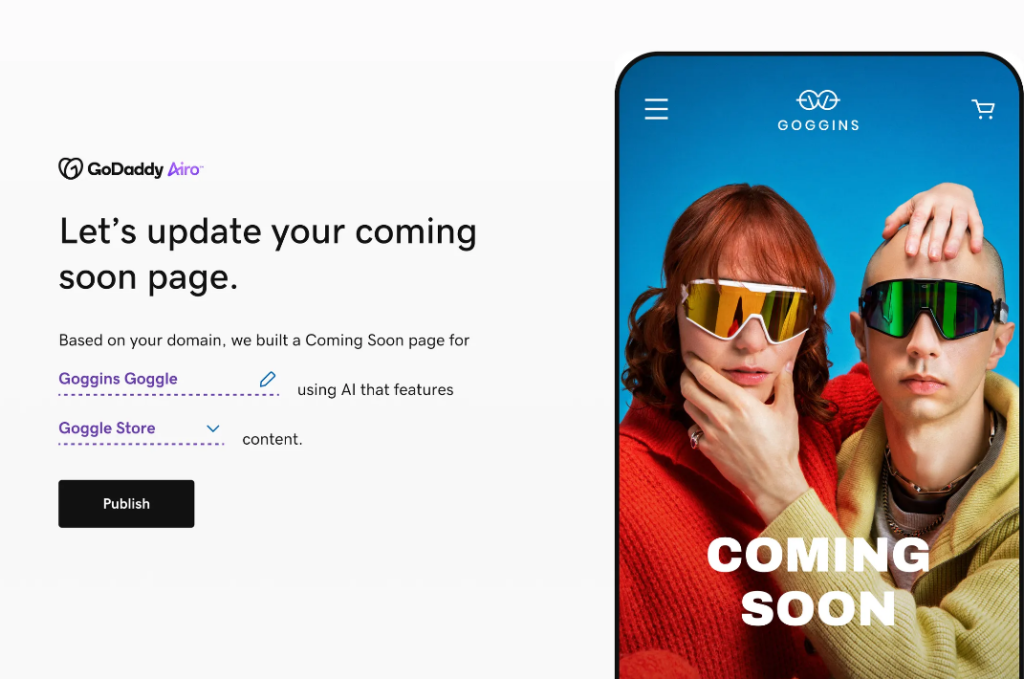
Source: GoDaddy
What changed: in the past, creating a great website required either technical skills or hiring developers – both costly for a small business. While the support from experienced developers is still valuable and often required, in 2026, smart builders and no-code tools cut those barriers down. They enable faster launch times and lower development costs, meaning an SMB can update their site or roll out a new landing page on the fly.
This agility is crucial for growth – you can respond to market changes (say, spinning up a page for a new service or promotion) without weeks of development. AI assistance also ensures that best practices are baked in.
This trend is directly about website strategy. Owning a domain isn’t enough – you need an up-to-date site on it. AI-powered site builders ensure your domain can host a professional, mobile-friendly website with minimal effort.
For SMBs entering new markets or launching microsites, no-code tools also make it easy to use multiple domains or subdomains effectively (e.g. creating region-specific sites or campaign-specific pages) without heavy lifting. Ultimately, this democratization of web development means any SMB can leverage their domain to its full potential – a sleek website that’s easily managed and quickly improved over time.
As cyber threats grow, SMBs in 2026 are taking security as seriously as big enterprises. This involves both general cybersecurity measures and specific domain protections. Key elements include: ensuring every website has TLS/SSL encryption (that padlock icon in the browser) for safe data transfer, implementing email security protocols to prevent scammers from spoofing your domain’s email, and using DNSSEC (Domain Name System Security Extensions) to guard against domain hijacking or DNS tampering.
Many businesses are also adopting a “zero trust” approach internally – never trusting, always verifying every access – but at minimum, client-facing systems like your website and email must be locked down.

Source: Pexels
Why should you care: small businesses are unfortunately prime targets for cyber attacks. Over 81% of SMBs suffered a security or data breach in the past year, and increasingly attackers use AI to craft sophisticated phishing and malware that can fool even savvy users.
A single breach can be devastating – leading to financial loss, downtime, legal liabilities, and a broken reputation. Customers also have become more aware of online security signals. If they see “Not Secure” warnings on your site or receive weird emails from your domain, trust evaporates fast.
By investing in security, SMBs protect their operations and signal professionalism to customers. Notably, Google and other tech companies are penalizing sites that don’t meet security standards (for example, Chrome flags non-HTTPS sites, and Google Search may rank them lower).
SMBs should ensure their domain provider or hosting includes free SSL and set it to auto-renew so the certificate never lapses. Likewise, configuring DMARC/SPF/DKIM for your domain’s email prevents attackers from impersonating your business in spam or fraud attempts – this protects your customers and your brand’s reputation.
Enabling features like registrar lock and DNSSEC adds another layer by making it extremely hard for someone to hijack your domain or redirect traffic maliciously. By building these safeguards into their domain strategy, small businesses establish trust with every visitor – users can browse and transact on the site with confidence that their data is safe.
In 2026, personalized user experiences are becoming the norm. AI-driven personalization means your website dynamically adapts content to each visitor – showing relevant offers, recommendations, or messaging based on user data.
Modern websites can detect how a visitor arrived, their location, or past behavior, and then adjust on-page elements (calls-to-action, featured products, etc.) accordingly. Beyond the website itself, personalization extends to emails, ads, and chat interactions all tuned to individual preferences using AI and customer data.

Source: Pexels
How can you leverage it: customers now expect a tailored experience. 75% of business leaders say customers demand a more personal touch than before. When SMBs deliver personalized service – such as content that speaks directly to a visitor’s needs or quick responses aligned to a customer’s history – it drives engagement and loyalty. Happy customers are more likely to convert and become repeat buyers
For small businesses, this can be a huge growth driver. Your domain is often the first touchpoint – e.g. someone lands on your homepage – so that’s where personalization can immediately impress. AI tools can customize homepage banners, recommend the right product, or even tweak the site navigation for different visitor segments.
For example, SMB sites in 2026 alter calls-to-action based on traffic source, highlight location-specific services, or adjust copy for returning vs. new visitors. This reduces friction: visitors find what they need faster because the site “meets them where they are.”
Additionally, integrating your website with an AI-powered CRM ensures that data from contact forms or user behavior on your domain feeds into email campaigns and remarketing – creating a seamless personalized journey whether the customer is on your site, social media, or reading your newsletter.
The “AI agent revolution” has arrived for customer service and operations. Conversational AI refers to smart chatbots or virtual assistants that can interact with users in natural language and perform tasks.
Unlike the clunky bots of a few years ago, 2026’s AI assistants can handle complex requests: answering customer questions on your website 24/7, helping users find products, booking appointments, or even initiating outreach like personalized follow-up emails. These agents use advanced language models and are often integrated with a company’s backend data (like inventory or CRM info) to take actions, not just chat.

Source: Unsplash
Why use it: small businesses can now provide round-the-clock customer engagement and support without hiring large teams. This is a game-changer for productivity and scalability. For instance, an AI chatbot on your site can instantly answer FAQs or troubleshoot basic issues, so customers don’t wait for an email reply or phone call – improving satisfaction.
On the operations side, AI agents can automate tedious tasks like order processing or scheduling, freeing up your staff to focus on higher-value work. Notably, growing SMBs are nearly twice as likely to be investing in AI than their struggling peers because they see immediate returns in efficiency and revenue.
Your website is the natural home for a lot of this conversational AI. Embedding an AI chat widget on your domain means visitors can ask questions like “Do you have this item in stock?” or “What are your rates?” and get instant answers. This keeps potential customers on your site longer and guides them toward a sale or contact form without frustration.
Furthermore, these bots can be programmed to escalate to a human or collect lead information if needed (“Can I get your email to have our expert follow up?”). The result is higher conversion rates from your existing web traffic. Beyond on-site chat, SMBs are also using AI to automate follow-ups – e.g. an AI might email a website visitor with a personalized note or offer after their visit, using data from what pages they viewed. All of this leverages your domain as a central point of customer engagement, available anytime.
Whether it’s leveraging AI to create content and engage visitors, or shoring up your domain’s security and performance, these technology trends all point toward a common theme: providing a better, smarter online experience for your customers. Your website and domain strategy lie at the heart of this effort – they are the platform on which AI, security, and creative marketing all converge. By embracing the trends most relevant to your business, you can grow your online presence globally, efficiently, and securely.
In 2026, top tech trends for SMBs include AI content creation, personalized websites, smart site builders, domain security, and conversational AI.
AI helps SMBs create better content, automate marketing, personalize websites, and offer 24/7 customer support through chatbots - boosting engagement and sales.
Personalized websites show tailored content and offers based on visitor behavior, improving user experience, increasing conversions, and driving repeat visits.
Use SSL certificates, enable DMARC/SPF/DKIM email security, lock your domain, and activate DNSSEC to secure your site and maintain customer trust.
Yes - modern AI website builders can create professional, optimized sites in minutes, saving time and money while ensuring mobile and SEO readiness.
Looking for the latest trends for your business to adopt? Visit it.com Domains blog and follow us on social media.
Continue reading on the it.com Domains blog...
Whether you're launching your first site or looking to scale your online presence, now’s the time to tap into tech designed to make your business more agile, visible, and secure. From AI that writes and personalizes your content, to smarter ways to build and protect your domain, we have collated five of the most important tech trends every business owner should know in 2026.
AI-Powered Content Creation & SEO Optimization
Generative AI has become a “marketing sidekick” for SMBs, helping produce website content, blog posts, product descriptions, and more. Modern AI tools can draft articles, suggest keywords, and even optimize your website copy for better search visibility. Notably, search engines are themselves using AI to summarize answers for users, which means content needs to be clear and well-structured to get picked up.
AI is also changing SEO and reshaping it into Generative Engine Optimization – businesses are realizing the game is shifting from just ranking on Google to being the trusted source that AI assistants cite in their answers. With the launch of end-to-end AI experiences like ChatGPT Atlas AI-enabled browser, it’s crucial that your website speaks the same language as AI agents do.
Source: Pexels
Why it matters: high-quality content is key to attracting customers online, but producing it consistently is resource-intensive. A boost in content output from AI (when guided by human expertise) helps SMBs compete with larger firms in educating and engaging their audience.
In fact, 88% of organizations use AI in at least one business function, and many are now scaling up “agentic” AI systems for content and insight generation. By 2026, SMBs that figure out how to use AI to generate helpful, credible content will stand out against competitors and against a wave of low-quality AI spam.
Your website is the primary outlet for all this AI-generated content. Embracing AI-driven writing means you can keep your site updated with fresh blog posts, FAQs, and product info that attract search traffic.
It’s crucial, however, to maintain authenticity and accuracy – pairing AI with human review ensures content truly answers customer questions (and avoids factual errors). Structuring content for AI-driven search is also important: clear headings, schema markup, and authoritative info help AI search tools recognize your site as a trusted source. In short, AI content tools can amplify your website’s reach if used thoughtfully, with your domain becoming known as an authoritative hub for your niche.
No-Code Website Development
Building and managing a professional website is now easier than ever thanks to no-code platforms and AI-assisted site builders. These tools allow SMB owners to create websites through simple drag-and-drop interfaces or even by having a conversation with an AI assistant.
For instance, GoDaddy Airo allows you to create a full AI-generated website in minutes. Similarly, modern no-code platforms (for websites and web apps) let you add features or integrations via visual editors instead of complex coding.
Source: GoDaddy
What changed: in the past, creating a great website required either technical skills or hiring developers – both costly for a small business. While the support from experienced developers is still valuable and often required, in 2026, smart builders and no-code tools cut those barriers down. They enable faster launch times and lower development costs, meaning an SMB can update their site or roll out a new landing page on the fly.
This agility is crucial for growth – you can respond to market changes (say, spinning up a page for a new service or promotion) without weeks of development. AI assistance also ensures that best practices are baked in.
This trend is directly about website strategy. Owning a domain isn’t enough – you need an up-to-date site on it. AI-powered site builders ensure your domain can host a professional, mobile-friendly website with minimal effort.
For SMBs entering new markets or launching microsites, no-code tools also make it easy to use multiple domains or subdomains effectively (e.g. creating region-specific sites or campaign-specific pages) without heavy lifting. Ultimately, this democratization of web development means any SMB can leverage their domain to its full potential – a sleek website that’s easily managed and quickly improved over time.
Cybersecurity and Domain Trust Protection
As cyber threats grow, SMBs in 2026 are taking security as seriously as big enterprises. This involves both general cybersecurity measures and specific domain protections. Key elements include: ensuring every website has TLS/SSL encryption (that padlock icon in the browser) for safe data transfer, implementing email security protocols to prevent scammers from spoofing your domain’s email, and using DNSSEC (Domain Name System Security Extensions) to guard against domain hijacking or DNS tampering.
Many businesses are also adopting a “zero trust” approach internally – never trusting, always verifying every access – but at minimum, client-facing systems like your website and email must be locked down.
Source: Pexels
Why should you care: small businesses are unfortunately prime targets for cyber attacks. Over 81% of SMBs suffered a security or data breach in the past year, and increasingly attackers use AI to craft sophisticated phishing and malware that can fool even savvy users.
A single breach can be devastating – leading to financial loss, downtime, legal liabilities, and a broken reputation. Customers also have become more aware of online security signals. If they see “Not Secure” warnings on your site or receive weird emails from your domain, trust evaporates fast.
By investing in security, SMBs protect their operations and signal professionalism to customers. Notably, Google and other tech companies are penalizing sites that don’t meet security standards (for example, Chrome flags non-HTTPS sites, and Google Search may rank them lower).
SMBs should ensure their domain provider or hosting includes free SSL and set it to auto-renew so the certificate never lapses. Likewise, configuring DMARC/SPF/DKIM for your domain’s email prevents attackers from impersonating your business in spam or fraud attempts – this protects your customers and your brand’s reputation.
Enabling features like registrar lock and DNSSEC adds another layer by making it extremely hard for someone to hijack your domain or redirect traffic maliciously. By building these safeguards into their domain strategy, small businesses establish trust with every visitor – users can browse and transact on the site with confidence that their data is safe.
AI-Driven Personalization & Customer Experience
In 2026, personalized user experiences are becoming the norm. AI-driven personalization means your website dynamically adapts content to each visitor – showing relevant offers, recommendations, or messaging based on user data.
Modern websites can detect how a visitor arrived, their location, or past behavior, and then adjust on-page elements (calls-to-action, featured products, etc.) accordingly. Beyond the website itself, personalization extends to emails, ads, and chat interactions all tuned to individual preferences using AI and customer data.
Source: Pexels
How can you leverage it: customers now expect a tailored experience. 75% of business leaders say customers demand a more personal touch than before. When SMBs deliver personalized service – such as content that speaks directly to a visitor’s needs or quick responses aligned to a customer’s history – it drives engagement and loyalty. Happy customers are more likely to convert and become repeat buyers
For small businesses, this can be a huge growth driver. Your domain is often the first touchpoint – e.g. someone lands on your homepage – so that’s where personalization can immediately impress. AI tools can customize homepage banners, recommend the right product, or even tweak the site navigation for different visitor segments.
For example, SMB sites in 2026 alter calls-to-action based on traffic source, highlight location-specific services, or adjust copy for returning vs. new visitors. This reduces friction: visitors find what they need faster because the site “meets them where they are.”
Additionally, integrating your website with an AI-powered CRM ensures that data from contact forms or user behavior on your domain feeds into email campaigns and remarketing – creating a seamless personalized journey whether the customer is on your site, social media, or reading your newsletter.
Conversational AI and Chatbot Automation
The “AI agent revolution” has arrived for customer service and operations. Conversational AI refers to smart chatbots or virtual assistants that can interact with users in natural language and perform tasks.
Unlike the clunky bots of a few years ago, 2026’s AI assistants can handle complex requests: answering customer questions on your website 24/7, helping users find products, booking appointments, or even initiating outreach like personalized follow-up emails. These agents use advanced language models and are often integrated with a company’s backend data (like inventory or CRM info) to take actions, not just chat.
Source: Unsplash
Why use it: small businesses can now provide round-the-clock customer engagement and support without hiring large teams. This is a game-changer for productivity and scalability. For instance, an AI chatbot on your site can instantly answer FAQs or troubleshoot basic issues, so customers don’t wait for an email reply or phone call – improving satisfaction.
On the operations side, AI agents can automate tedious tasks like order processing or scheduling, freeing up your staff to focus on higher-value work. Notably, growing SMBs are nearly twice as likely to be investing in AI than their struggling peers because they see immediate returns in efficiency and revenue.
Your website is the natural home for a lot of this conversational AI. Embedding an AI chat widget on your domain means visitors can ask questions like “Do you have this item in stock?” or “What are your rates?” and get instant answers. This keeps potential customers on your site longer and guides them toward a sale or contact form without frustration.
Furthermore, these bots can be programmed to escalate to a human or collect lead information if needed (“Can I get your email to have our expert follow up?”). The result is higher conversion rates from your existing web traffic. Beyond on-site chat, SMBs are also using AI to automate follow-ups – e.g. an AI might email a website visitor with a personalized note or offer after their visit, using data from what pages they viewed. All of this leverages your domain as a central point of customer engagement, available anytime.
Whether it’s leveraging AI to create content and engage visitors, or shoring up your domain’s security and performance, these technology trends all point toward a common theme: providing a better, smarter online experience for your customers. Your website and domain strategy lie at the heart of this effort – they are the platform on which AI, security, and creative marketing all converge. By embracing the trends most relevant to your business, you can grow your online presence globally, efficiently, and securely.
FAQs
What are the top tech trends for small businesses in 2026?
In 2026, top tech trends for SMBs include AI content creation, personalized websites, smart site builders, domain security, and conversational AI.
How can AI help grow my small business online?
AI helps SMBs create better content, automate marketing, personalize websites, and offer 24/7 customer support through chatbots - boosting engagement and sales.
Why is website personalization important in 2026?
Personalized websites show tailored content and offers based on visitor behavior, improving user experience, increasing conversions, and driving repeat visits.
What should SMBs do to protect their domains in 2026?
Use SSL certificates, enable DMARC/SPF/DKIM email security, lock your domain, and activate DNSSEC to secure your site and maintain customer trust.
Are AI website builders good enough for small business sites?
Yes - modern AI website builders can create professional, optimized sites in minutes, saving time and money while ensuring mobile and SEO readiness.
Looking for the latest trends for your business to adopt? Visit it.com Domains blog and follow us on social media.
Continue reading on the it.com Domains blog...



