


godaddy
New Member
ICANN Accredited Registrar
Domain Marketplace
Domain Broker
Hosting Provider
ICA Member
ISO 27001
- Joined
- Jan 26, 2009
- Messages
- 151
- Reaction score
- 13
- Selling a domain name is the process of transferring ownership of a registered web address to a buyer in exchange for payment.
- Use domain appraisal tools and study comparable sales to set realistic, competitive pricing for your domain.
- Choose the right platform for your goals: GoDaddy Auctions for active buyers, Afternic for global reach, or Dan.com for quick transactions.
- Optimize your listing with relevant keywords and highlight branding potential to attract serious buyers.
- Use a secure escrow service to protect both parties and ensure a smooth transaction.
- Communicate clearly during negotiations and follow proper transfer steps for a seamless handoff of ownership.
Selling a domain name can be a smart way to turn a digital asset into profit. Maybe you bought a domain name years ago that’s now in demand, or you’ve built a portfolio of domains ready to sell. Whatever your reason, understanding how to sell a domain name the right way can help you get the best return on your investment.
And you don’t even need a website to do it.
Find the value of any domain name today

GET VALUE

Our step-by-step guide will show you exactly how to list, sell, and deliver your domain name to its new owner. Let’s jump straight in!
With over 80+ million domains under management, GoDaddy is the world’s largest domain registrar – and its integrated marketplace, auction platform, and broker services make it one of the most complete ecosystems for buying and selling domains.
How to sell a domain name: Quick steps
- Determine your domain’s value using appraisal tools and comparable sales data.
- Set your pricing strategy: choose between fixed pricing or flexible bidding.
- Prepare the domain for sale (pre-listing checklist).
- Choose a selling platform such as GoDaddy Auctions, Afternic, or Dan.com.
- Put your domain on the market: optimize listing, find buyers, and be ready to negotiate.
- Use an escrow service to secure payment and protect both parties.
- Transfer the domain to the new owner following registrar guidelines.
Should you sell your domain name?
There are several reasons why you might consider selling your domain. Let’s take a look at some of the reasons why, as well as what you should check before attempting to sell your domain. Plus, selling domains isn’t limited to tech experts or large-scale investors — anyone with a valuable name can participate.
Reasons to sell a domain
As more businesses and entrepreneurs look for the perfect domain to match their brand, the demand for unique, memorable web addresses continues to grow. If you’ve been holding onto a unique domain (or several), selling your domain might be a worthwhile venture.
Here are some other reasons you might consider selling domains:
- There’s a low barrier to entry: Domains typically range from $10-20 per year, making them an accessible investment.
- Domains can be a passive income source: A domain can be listed on a domain selling platform and attract buyers without ongoing effort.
- Demand is constant: Every new business needs a domain name, and older/established domains can be hard to come by.
- Potential for high profit margins: With the low cost of entry, domains can sometimes earn hundreds or even thousands of dollars in the resale market.
How to check if your domain is sellable
If you’re leaning towards selling your domain, here’s a quick self-check you can run through to see if your domain is worth selling:
- Is your domain short and/or easy to spell?
- Do you have an in-demand domain extension, such as .com?
- Does your domain include popular keywords or brandability?
- Has your domain been registered for a long period of time?
- Does the domain have existing traffic or backlink history?
- Are there clear business uses for your domain name?
If you answered yes to more questions than no, then you’re more likely to be able to successfully sell your domain name.
Check out GoDaddy’s new domain auctions page layout if you’re interested in pursuing domain investing. The new layout provides the tools investors need to accurately gauge which domain names are worth the money.
What to do if your domain isn’t that desirable
There is a chance that your domain name may not sell, even if you met many of the requirements we covered above. None of the points above will guarantee that your domain is popular on the domain aftermarket, and that’s okay. You can still list your domain for sale, but be aware that it may sell for less than you’d hoped for, or take longer to sell than other domains.
If you decide not to sell your domain name, you can always choose to hold onto the domain for now. There’s always a chance that a future startup or innovation might make your domain desirable. You can also build a website using your domain, or park it. Keeping it in use is a good idea on the off chance that someone finds it and wants to make an offer.
Check for trademark and legal risks before you sell
Before listing your domain, you’ll want to check for trademarks first. To do this, do a quick search using your preferred search engine to see if the keywords associated with your domain are already in use. You’ll also want to search the trademark database to make sure that your domain isn’t infringing on an existing trademark.
This step is crucial, as a trademark violation can quickly turn your attempt at selling a domain name into a legal dispute.
Pricing a domain: how much is it worth?
First, you’ll want to set a price for your domain. Choosing your pricing is a balancing act, so here are some tools to help you set a fair price:
Try the Domain Name Value and Appraisal tool
GoDaddy’s domain value and appraisal tool can help give a good starting point for what your domain is worth. This tool uses an exclusive algorithm that combines machine learning with real-market sales data compiled from GoDaddy’s 20+ years of experience in the domain space.
Using that information, a domain owner considering selling may wish to immediately sell their domain name or treat the domain like an investment and hold it to see if its value rises in the future. Knowledge is power!
Check similar domain sales
Looking around at what other domain names are selling for is another great way to get a sense of the market value of your domain. To do this, you can seek out specialized domain name marketplaces or websites that track and report on domain name transactions. Examples of this would be websites like NameBio, Domain Name Wire, or NamePros.
When it comes to using sales data to try to figure out a fair price for your domain name, factors to consider are domain length, keywords, extensions, and current relevance. These factors allow you to better identify pricing trends, assess demand for specific domain names, and gain a better overall understanding of the criteria used by domain buyers.
Asking price vs. actual sale price
When researching domain marketplaces to figure out what to set your asking price at, it’s important to keep in mind that the prices you’re seeing on the marketplace are what sellers are hoping for and not always what buyers will pay. Because of that discrepancy, it’s a better idea to anchor your pricing to completed sales instead. This helps to avoid overpricing (which is the most common reason domains fail to sell) and can help attract buyers more quickly.
Pro tips: How to spot hidden value in your domain
Not every domain’s value is obvious at first glance. Some names hold untapped potential that can significantly boost their market appeal. Here’s how to find your domain’s real worth:
- Niche relevance: Domains that fit emerging industries, tech trends, or specialized communities often gain traction over time.
- Branding potential: Short, memorable, and easy-to-pronounce names are attractive to startups and marketers looking to build a strong brand.
- Emotional connection: Names that evoke trust, excitement, or curiosity can resonate more with buyers.
- Versatile meaning: A domain that applies to multiple industries or audiences can appeal to a wider pool of buyers.
- Extension advantage: While .com remains dominant, other extensions like .io or .ai can add modern appeal for tech and innovation-focused businesses.
Choose your pricing strategy
Now that you have a rough idea of your domain’s potential value, you’ll need to decide on a pricing strategy. There are two main approaches:
- Fixed pricing: Set a specific, non-negotiable price for your domain. This approach is straightforward and can work well for highly valuable domains with a clear market value. However, it may limit your negotiating power.
- Flexible pricing: List your domain at a higher “buy it now” price, but also set a lower “minimum bid” or “reserve price” that you’re willing to accept. This strategy allows for negotiation and can help attract more potential buyers.
For example, let’s say you have a domain name that, based on your research, could be worth anywhere from $1000 to $2500. You could list it with a fixed price of $2000 or set a reserve price of $1000 and a buy-it-now price of $2500. There’s no hard-and-fast rule here, but if you believe that there’s a competitive market for your domain name, allowing users to bid can end up working in your favor.
Ultimately, the right pricing strategy depends on your domain’s value, your negotiation skills, and your willingness to be flexible. The goal here is to maximize your return while also attracting serious buyers.
| Fixed price (Buy it now) | Offer pricing | Auction/reserve price | |
|---|---|---|---|
| How it works | Set price. The buyer either pays or leaves. | No fixed price. “Make an offer” option allows buyers to send an offer and negotiations begin. | Buyers place bids within a set auction time. A reserve minimum price. |
| Best for | Domains with a clear market value and sellers who want a quick, simple sale. | Domains with an uncertain value, or unique names. | Names with competing interests, such as short, brandable, or keyword-rich domains. |
| Pros |
|
|
|
| Cons |
|
|
|
| Speed | Fast | Medium (depends on negotiations) | Fast (if bidders are interested) |
Prepare your domain for sale
Doing a bit of preparation now will help you avoid delays down the road. Here’s a quick pre-listing checklist to help you get your domain ready to sell:
- Check with your domain registrar to ensure that your domain is able to be transferred (60-day locks can be applied to certain domain extensions after purchases, renewals, or contact updates).
- Make sure that your domain isn’t expiring soon.
- Confirm that you can access your domain account.
- Create a dedicated email for inquiries.
Another step you’ll want to take is to ensure that your contact information is available in WHOIS searches for your domain. If you’re unfamiliar, WHOIS is a public directory that stores information about registered domain names, including the contact details of the domain owner.
When selling a domain name, you’ll want to have your contact information listed on the WHOIS record to expedite communication between you and potential buyers. However, if you’re uncomfortable doing so, you’ll want to ensure you’ve enabled message forwarding for your domain privacy services.
Choose where to sell your domain
After settling on a price and prepping your domain details for a sale, it’s time to choose where you’d like to sell your domain.
GoDaddy Auctions
GoDaddy Auctions is one of the most trusted platforms for selling domain names, especially for those who already have an account with GoDaddy, a leading domain registrar. Its seamless integration with the GoDaddy ecosystem makes listing, tracking, and managing your domain sales simple and efficient.
With GoDaddy Auctions, you can choose from multiple selling options, including fixed-price listings, auctions, and a brokerage service for high-value domains.
The platform’s built-in visibility gives your domain an extra advantage by automatically promoting it across GoDaddy’s network to reach a wider audience of active buyers. It’s a streamlined way to connect your domain with serious buyers and make the most of GoDaddy’s trusted marketplace.
Afternic
Afternic (a GoDaddy-owned brand) is a well-established and reputable domain marketplace that has been around since 1999. One of the key advantages of using Afternic is its extensive reach and visibility. With Afternic domains being listed across multiple domain registrars, your domain name is more likely to get exposure to a larger pool of potential buyers.
Additionally, Afternic offers a variety of selling options, including buy-it-now fixed-price listings, auctions, lease-to-own, and a brokerage service for high-value domains.
Afternic’s listing process is straightforward, and the platform provides comprehensive tools and analytics to help you price your domain effectively and monitor its performance. The platform also offers escrow services and secure payment processing, ensuring a safe and hassle-free transaction for both buyers and sellers.
While Afternic charges fees for its services, the potential for reaching a global audience and the added security measures make it a compelling choice for those looking to sell their domain names.
Dan.com
Dan.com (a GoDaddy brand) is a relatively new player in the domain marketplace, but it has quickly gained popularity among domain investors and sellers. One of the key advantages of using Dan.com is its user-friendly interface and streamlined selling process. The platform allows you to list your domain names for sale with just a few clicks, making it an attractive option for those who value simplicity and ease of use.
Dan.com offers a variety of selling options, including fixed-price listings, auctions, and a brokerage service for high-value domains. The platform also provides detailed analytics and reporting tools, allowing you to track the performance of your listings and make informed decisions about pricing and marketing strategies.
One unique feature of Dan.com is its emphasis on transparency and fairness. The platform operates on a commission-based model, meaning you only pay a fee if your domain sells. Additionally, Dan.com does not charge any listing fees, making it a cost-effective option for those looking to sell their domain names without incurring upfront costs.
When to use a broker or sell privately
| Option | Pros | Cons | Best For |
|---|---|---|---|
| Domain Broker | Expert guidance Access to large buyer networks Negotiation handled for you | Commission fees Less control over the sale | High-value or premium domains |
| Private Sale | No fees Full pricing control | Time-consuming Must handle negotiation and communication yourself | Mid- to lower-value domains or direct buyer interest |
Park the domain while you wait
Domain parking is a viable option for those looking to monetize their domain names while awaiting a potential buyer. You can generate passive income through pay-per-click advertising revenue by parking your domain. When visitors land on your parked domain, they’ll be presented with relevant ads, and you’ll earn a share of the revenue each time someone clicks on those ads.
This approach is particularly appealing if you own a high-traffic domain or one that’s closely related to popular search terms. The more relevant and valuable your domain is, the higher the likelihood of generating substantial advertising revenue through domain parking services.
With all that said, it’s essential to note that domain parking should not be viewed as a long-term strategy for maximizing your domain’s value. While it can provide a steady stream of income in some cases, the real potential lies in finding the right buyer who recognizes the domain’s worth and is willing to pay a premium price.
Put your domain on the market
Now that you’ve decided on a strategy and prepped your domain to sell, it’s time to list. Your goal here is to list your domain correctly, find well-matched buyers, fine-tune your negotiations, and keep yourself (and your domain) safe.
1. Create a listing and landing page
Develop a simple website showcasing the domain’s features, potential uses, and value proposition. This can help buyers visualize the domain’s potential and increase its perceived worth. You’ll want to stay accurate and avoid exaggeration. Here’s a quick list of what you should include:
- Domain description
- Price or “make an offer” button, depending on how you plan to sell
- Example use cases for the domain
- Traffic/domain history information
- Contact information
2. Find buyers for your domain
To get your domain noticed, you’ll want to prepare an enticing sales pitch that highlights the domain’s unique qualities, potential branding opportunities, and any existing traffic or search engine authority. Then, utilize multiple platforms to list and market your domain, including specialized domain marketplaces, auction sites, and social media channels. Networking within industry forums and reaching out to potential buyers directly can also help you find the right purchaser who sees the true value of your domain.
Passive selling: marketplaces and landing pages
Domain listings and “for sale” pages work in the background. They can be a source of passive income, but waiting for sellers to find you can take a long time (if they find you at all). It’s a good idea to combine listings and landing pages with active outreach, when possible.
Active selling: direct outreach
Identify businesses, startups, or individuals who could benefit from your domain and reach out directly. Personalized messages that explain how the domain supports their goals can increase your chances of landing a serious buyer. Don’t mass-email potential buyers; keep your messages personal and tailored to the recipient.
Not sure what to say in your outreach email? Here’s a short example of what to include:
Subject: Acquisition Opportunity: [add your domain]
Hi [name],
I hope this message finds you well. My name is [your name], and I’m reaching out because I currently own the domain [their domain] and believe it could be a strong asset for your brand.
Given your presence in the [relevant industry] space, I thought this domain might be a natural fit: it’s short, memorable, and immediately communicates what you do. It could save you years of SEO groundwork and reinforce brand credibility from day one.
I’m open to discussing a sale and happy to work with an escrow service to ensure a smooth and secure transaction for both parties.
If you’re interested or would like to learn more, feel free to reply to this email or reach me at [your email/phone]. I’d be glad to hop on a quick call at your convenience.
Thanks for your time, and I look forward to hearing from you!
Best regards,
[Your name]
[Your contact information]
3. Promote your domain on forums, social media, and ads
Share your domain on platforms where entrepreneurs, investors, and brand builders gather. Highlight its unique appeal and how it could fit into specific industries or business ideas to spark interest and drive traffic to your listing.
Also, consider running targeted ads on relevant websites or platforms frequented by potential buyers in your domain’s niche or industry.
4. Negotiate the sale
When negotiating, be sure to keep these tips in mind:
- Be prepared to negotiate and remain flexible with your pricing.
- Keep a minimum acceptable price in mind, but remember that being open to reasonable offers can help you close a sale more quickly.
- Maintain professionalism throughout the sales process to build trust.
- Respond promptly, provide accurate information, and be transparent.
5. What to agree on before you close
Once you’ve found a buyer and have reached a tentative agreement, the next step is to finalize the details. You’ll need to come to an agreement on the final price, who pays which fees, the payment method to be used, what’s included with the sale, and the domain transfer timeline. Be sure to get this agreement in writing, preferably in plain language so that both parties fully understand what’s being agreed to.
Use an escrow service to get paid safely
Using an escrow service when selling a domain name is a critical step that helps better protect both the buyer and the seller from potential risks, as well as ensuring a smooth transaction process. Reputable escrow services typically offer additional features, such as domain transfer assistance, dispute resolution mechanisms, and secure communication channels.
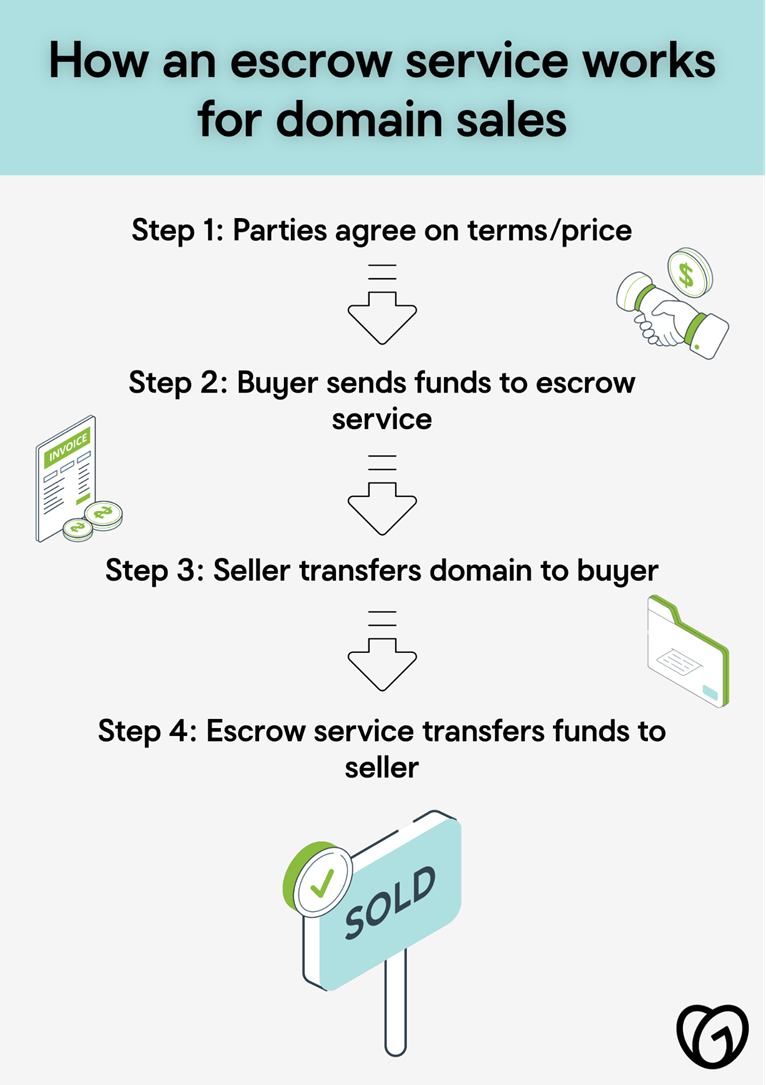
An escrow service acts as a trusted third party that holds the domain and the payment until both parties have fulfilled their respective obligations. Here’s how that process typically plays out:
- Parties agree on the terms of the domain purchase.
- Buyer pays the agreed-upon price to the escrow service.
- Seller then transfers the domain name to the buyer.
- The escrow service transfers the funds to the seller.
Transfer the domain name
Once you’ve sold your domain name, it’s time to transfer it to the new owner. Many domain listing sites will handle the transfer for you, but either way, it’s important to understand how a domain transfer works. The process can vary slightly depending on the registrar, but generally follows a similar pattern.
For example, if you’re transferring a domain from GoDaddy, you’ll need to unlock the domain and obtain an authorization code (also known as an EPP code). This code is required to start the transfer process and serves as a security measure. Once you have the code, you’ll need to provide it to the buyer, who will then initiate the transfer process with their chosen registrar.
The duration of a domain transfer can vary, but it typically takes between 5 and 7 days to complete.
However, there are instances where the process can be delayed due to certain issues. One common issue is a domain being locked or on hold, which can prevent the transfer from going through. This situation can arise if there are outstanding fees or disputes associated with the domain. In such cases, the seller must resolve the issue with the registrar before proceeding with the transfer.
Another potential issue is the domain’s expiration date being too close. Most registrars have a policy that prohibits transfers within a certain window before the domain’s expiration date. If this is the case, the seller may need to renew the domain before initiating the transfer.
To avoid delays, it’s essential to communicate openly with the buyer and follow the registrar’s guidelines closely. Additionally, it’s recommended that the transfer process be initiated well before any deadlines to ensure a smooth and timely ownership transition.
After the sale: fees, taxes, clean-up
We touched on fees briefly earlier in this guide, but to expand a bit on the fees that you should expect, they include:
- Transfer fees (paid to the new registrar, typically $10-20)
- Escrow service fees (paid to the escrow service, typically 2.5%-5% of the domain purchase price)
These fees vary widely by the provider that you choose to use, so be sure to review those and include them in your negotiations.
Additionally, domain sales are taxable, so be sure to keep your transaction records to file during your quarterly or annual tax filings.
And last, don’t forget to turn off any auto-renewal settings that you may still have for services related to that domain, and take down any active listings.
Disclaimer: This content should not be construed as legal or tax advice. Always consult an attorney or tax professional regarding your specific legal or tax situation.
Important tips when selling a domain
You might encounter some unexpected bumps when attempting to sell your domain, but most of the hassles are avoidable with a bit of research (and by using a reputable platform to sell your domain).
How to handle low offers
It might be tempting to ignore low offers, but a better route would be to politely counter the offer while referencing comparable sales. Low offers can sometimes result in a successful domain transaction, so it’s worth the response.
Here’s an example of how you might respond:
Hi [name],
Thank you for your offer. Unfortunately, $[X] is a bit below what the current market supports for this particular domain. Here are a few recent comparable sales to provide some context:
[provide researched comparable recent domain sales]
With that in mind, I’d like to counter at $[Y]. I’m open to discussion and looking forward to working with you.
Best,
[Your name]
[Your contact information]
Monitor industry trends (timing is everything)
Timing can be crucial in domain sales. Monitor industry trends, emerging markets, and potential buyers who might find your domain particularly valuable. Sometimes holding onto a domain until the right opportunity presents itself can result in a significantly better sale price.
That being said, sometimes holding a domain too long can be the wrong move as well. Keeping an eye on overall trends can help avoid holding onto the domain too long (or letting it go too soon).
Be professional before, during, and after the sale process
It’s key to maintain professionalism throughout the sales process. Respond promptly to inquiries, provide accurate information, and be transparent about the domain’s history and potential. A professional approach can help build trust and increase the likelihood of a successful sale.
Avoid domain sale scams: Red flags to watch for
Scams aren’t uncommon in the domain aftermarket, unfortunately. Here’s a quick rundown of the most common scams to watch out for:
- A payment screenshot instead of confirmed funds
- Pressure to transfer before payment is sent
- Requests to move off of the domain sales platform
- Overpayment/refund tricks
- Unclear buyer identity
If you’re concerned about your safety or privacy when selling your domain publicly, there are a few ways to better protect yourself. Always sell/list your domain name through a legit domain marketplace, a landing page, or direct contact rather than posting the domain in open forums. These options can help better protect you against potential theft attempts from bad actors.
Common mistakes to avoid when selling domains
Market saturation and difficulty in valuing your domain name are common problems that can be somewhat unavoidable when trying to sell your domain. However, there are other common issues that can be avoided, including:
- Over/underpricing your domain
- Ignoring trademarks
- Transferring the domain before payment is secured
- Being slow to reply to potential buyers
- Spamming/mass emailing too many possible buyers at once
- Not keeping track of offers across multiple listings
The good news is that most of these challenges can be managed with the right approach. Do your research before listing, be transparent about ownership, and use a reputable platform like GoDaddy Auctions to handle transactions securely. Building trust and communicating clearly can go a long way in closing a sale.
For a deeper look at what to avoid and how to navigate these challenges, check out this guide on domain investing pitfalls.
How to sell a domain name FAQ
Is it worth selling a domain name?Yes, selling a domain name can be worth it, especially if you’re holding one you no longer use or if there’s strong demand for it. Even a single sale can provide a solid return on a small initial investment. If you’re interested in turning unused domains into a steady source of income, you can learn how to build a domain portfolio and grow your presence in the aftermarket. For inspiration, read the Ali Zandi success story to see how one seller turned domain investing into a thriving business.
What is the best way to sell a domain name?
To sell a domain name, you’ll first need to determine your domain’s value. This can be done using tools like GoDaddy’s domain value appraisal tool and by comparing sales data on industry websites and forums. Then, you’ll need to choose your preferred sales platform, such as Afternic, Dan.com, or GoDaddy Auctions, to facilitate the domain purchase process.
Is domain selling easy?
If you have a desirable domain name, price it competitively, and utilize effective sales platforms and marketing strategies, selling it can be relatively straightforward. However, selling a less desirable domain name with no established presence can be quite challenging. It’s not a guaranteed quick and easy process.
What is the average selling price for a domain name?
There’s no single average selling price for a domain name. The price can range from a few dollars to millions, depending on a multitude of factors. Instead of looking for an average, it’s better to research comparable domain names. Look for domains with similar keywords, length, and TLDs that have recently sold to get a better idea of what a particular domain might be worth.
How long does it take to sell a domain name?
The timeline for selling a domain name varies widely and depends on several factors, including the domain’s perceived value, your asking price, and where you list it. A highly desirable domain — one that’s short, keyword-rich, or carries a popular extension like .com — can sell within days or weeks. Less sought-after domains, however, may sit on the market for months or even years before finding the right buyer.
To improve your chances of a faster sale, consider listing on multiple domain marketplaces, pricing competitively based on comparable sales data, and enabling features like “Buy It Now” pricing or broker services to attract serious buyers more quickly.
Can I sell a domain name without a website?
Yes, absolutely. A domain name is a standalone digital asset, and you do not need a website attached to it in order to sell it. That said, there are a few things you can do to make a bare domain more appealing to potential buyers:
- Park your domain on a landing page to signal that it’s for sale and capture inbound inquiries.
- Add a “For Sale” banner through your registrar or a marketplace so anyone who types in the URL immediately knows it’s available.
- List it on aftermarket platforms like GoDaddy Auctions, Afternic, or Dan.com, where buyers actively search for domains without ever visiting the domain itself.
Having a website can add value if it comes with existing traffic, content, or SEO authority, but it is by no means a requirement to complete a sale.
What’s the safest way to get paid for a domain?
The safest way to get paid when selling a domain name is through a trusted escrow service. Escrow acts as a neutral third party that holds the buyer’s funds securely until the domain has been successfully transferred, helping to protect both sides of the transaction from fraud.
Do I have to pay tax on a domain sale?
In most cases, yes. The proceeds from selling a domain name are subject to tax, but the exact rules depend on your state of residence, the size of the sale, and how you acquired the domain in the first place.
The post How to sell a domain name: A step-by-step guide appeared first on GoDaddy Blog.
Continue reading...


